Editor's pick
CSVGuide
Handling CSV Files Too Big to Open in Excel or Python
A decision guide for CSV files too big to open: look, count, sample, query in place, chunk, split, compress or convert, with numbers from a 1.3 GB file.
17 min read
Everything you need to level up your coding skills.
A decision guide for CSV files too big to open: look, count, sample, query in place, chunk, split, compress or convert, with numbers from a 1.3 GB file.
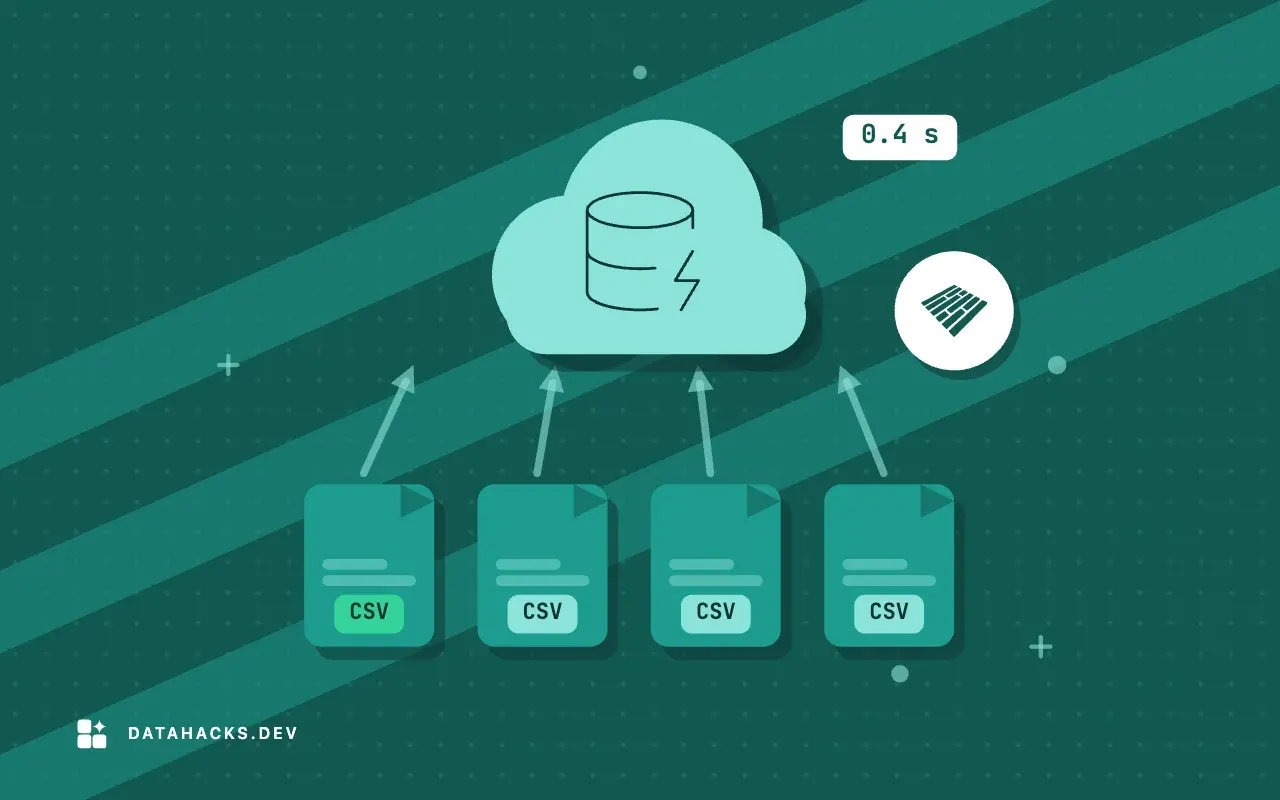
One DuckDB statement turned a 130 MB CSV into a 34 MB Parquet file; typed columns, dictionary encoding and min/max statistics explain the faster queries.
Stream XML into Arrow batches with lxml, query them in DuckDB at once, or try the community webbed extension. 1.2 million lines in 7.9 s with a 53 ms query.
Compute month over month growth with lag(): revenue of 46.50, 202.00 and 382.00 grew 334.4% and then 89.1%. Partial months, gaps and a zero base need care.
Find and fill missing days in a CSV time series: build a calendar with range(), left join the data and choose zero, carry-forward or interpolation.
Join two CSVs on a messy key: a strict join matched 1 of 4 orders, a normalized key matched 3, and an anti-join listed the rest. Check counts and duplicates.
Export a DuckDB query to CSV with COPY. Control the delimiter, NULL text, quoting, date format and compression, and split output into one file per value.
Join two CSV files on a key with plain SQL in DuckDB. Covers a 2M by 250k row join, keys that differ by case and spaces, left and anti joins, and type errors.
One COPY statement turns a CSV into Parquet in DuckDB. See the schema it writes, fix zip and money columns, compare compression codecs, and verify the result.
Use ignore_errors and store_rejects in DuckDB to read past bad CSV rows, then query reject_errors to see which lines were dropped and why.
A date column with five formats makes DuckDB fall back to text. Parse it with try_strptime and coalesce, list the failures, and avoid the day-first trap.
When the DuckDB CSV sniffer picks the wrong type, override it by column, read as text and cast, or narrow the candidate types. A test file shows each guess.
We send one email when a new article is published. No spam.